Infocomm Technology Club
Discover how the Infocomm Technology Club helps students build coding, digital media, and AI skills through hands-on projects and competitions.
Infocomm Technology Club
The Infocomm Technology Club provides students with opportunities to explore technology, digital media, and coding through hands-on projects and interactive activities. The club aims to develop students’ technical skills, creativity, and problem-solving abilities while fostering collaboration, leadership, and confidence. Through participation in projects and competitions, students gain practical experience and a deeper understanding of technology, equipping them with essential 21st-century skills.
Infocomm Technology Club
See how the Infocomm Club inspires curiosity and innovation while equipping students with essential digital skills for the future.
Teachers-in-Charge:
Mdm Lee Wee Fong (OIC)
Mr Jeremy Chan (Primary 3 Teacher-in-charge)
Ms Fannie Woo (Primary 4 Teacher-in-charge)
Ms Yvonne Tung (Primary 5 & 6 Teacher-in-charge)
Objectives:
To develop strong proficiency and confidence in ICT skills. To equip with a comprehensive understanding of technology and its applications. To cultivate creativity and inspire innovation.
The Primary 3 to Primary 6 students are introduced to different coding platforms and digital media production:
Photography
The Photography module is introduced to Primary 3 students as part of their foundational learning in digital media. This programme aims to nurture students’ creativity, observation, and storytelling skills through photography. It covers key areas such as camera handling, composition, lighting, photo editing, and photojournalism. Students gain hands-on experience in both studio and outdoor settings, participate in learning journeys, and build personal portfolios. The club also instils values such as teamwork, integrity, and empathy, with senior members taking on leadership roles and supporting school events through event photography. Students strengthen their confidence, communication, and critical thinking skills, fostering holistic character development and essential 21st-century competencies.
Apple New Media (Basics)
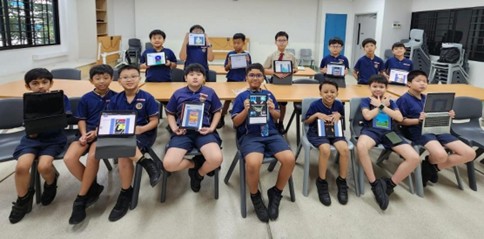
Through the Apple New Media programme, Primary 3 students equip themselves with essential techniques for content creation utilizing their iPads. The curriculum encompasses various subjects, including:
Photography
Videography
Augmented reality
Digital drawing
Introduction to artificial intelligence
Podcasting
AI4K (Intermediate)
Primary 4 students explore key Artificial Intelligence (AI) concepts, from AI algorithms, decision trees, speech recognition, and sentiment analysis to chatbots and AI ethics. They also learn about data quality, facial detection and recognition, pose estimation, recommendation engines, and reinforcement learning, gaining practical experience and understanding of responsible AI use.
Mobile App Development Using Thunkable
Primary 4 students are introduced to Thunkable, a beginner-friendly platform that enables app creation through visual coding. Through guided tutorials, they explored key programming concepts such as events, variables, and logic while designing simple apps like a music player and drawing pad. As their skills developed, they worked collaboratively to design their own interactive mobile apps, strengthening their teamwork, communication, and problem-solving abilities. The project culminated in a mini showcase, where students presented and demonstrated their apps to peers and Primary 2 students during the Primary 2 CCA Experience. This enriching, hands-on experience not only deepened their understanding of app development but also fostered creativity, critical thinking, and a passion for innovation. Here are the mobile apps which the students created:
My First App
Animal Sound App
Guardians of Galaxy
Whack a Pokemon
Southeast Asia Explorer
Book App
Ninja Training
Website Creation Using HTML
Primary 5 and Primary 6 students learn website creation using HTML through hands-on projects that equip them with skills in structuring web pages, formatting text, adding images, and integrating multimedia elements. Through this programme, they not only strengthen their web development skills but also develop collaboration, creativity, and social awareness as responsible digital learners.
Microsoft Game Development
The programme introduces the Primary 5 students to game development using MakeCode Arcade and Minecraft Education. Students learn to design and customize sprites, apply game mechanics, and incorporate sound and animation while exploring game design principles and storyboarding. In Minecraft Education, they develop skills in building, coding with Redstone and command blocks, and creating interactive game worlds. The programme concludes with a showcase where participants present their final games and receive feedback.
This programme helps students develop coding and game design skills, creative thinking, problem-solving, and teamwork. It also fosters confidence, resilience, and innovation, equipping them with essential 21st-century competencies.
Game-making Using Scratch
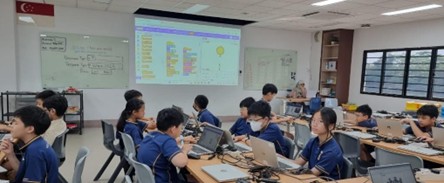
Using Scratch, Primary 5 students learn to code games through block-based programming, gaining hands-on experience with coding concepts such as loops, conditions, variables, events, and sequences. They begin by learning basic coding principles to strengthen their foundation and understand algorithms before progressing to actual game creation. Through the process, they develop creativity and design skills by planning projects, designing characters and backgrounds, and incorporating visual and audio elements. The platform also nurtures problem-solving and critical thinking, as students debug, refine, and logically sequence their code. Additionally, Scratch promotes collaboration, communication, and 21st-century skills, helping students build confidence, perseverance, and innovation while sharing ideas and working on group projects.
Four teams of students had the opportunity to broaden their learning by participating in two competitions (Singapore Infocomm Challenge SIC 2025, National Primary Games Creation & Coding Competition NPGC3). Through these experiences, they strengthened their coding skills and developed important qualities such as teamwork, organization, and time management to achieve their goals effectively.
Values in Action (VIA) Project
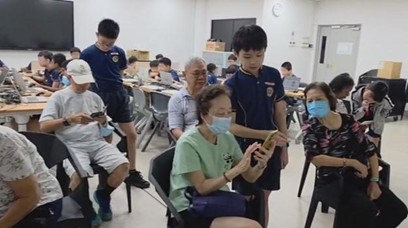
As part of the VIA project, the Primary 5 ICT Leaders extend their learning by guiding older adults in creating their own websites and teaching them how to use Canva to design picture collages. This authentic teaching experience enables students to apply their technical knowledge in real-world contexts while developing patience, communication, and mentorship skills. By working closely with the elderly, students also cultivate empathy, social awareness, and a sense of community responsibility, gaining a deeper appreciation for the importance of supporting others in embracing and learning new technologies.